
CNC Milling
CNC milling uses rotating multi-tooth cutters to shape flat surfaces, pockets, slots and contours in metal or plastic.

Part of CNC Machining
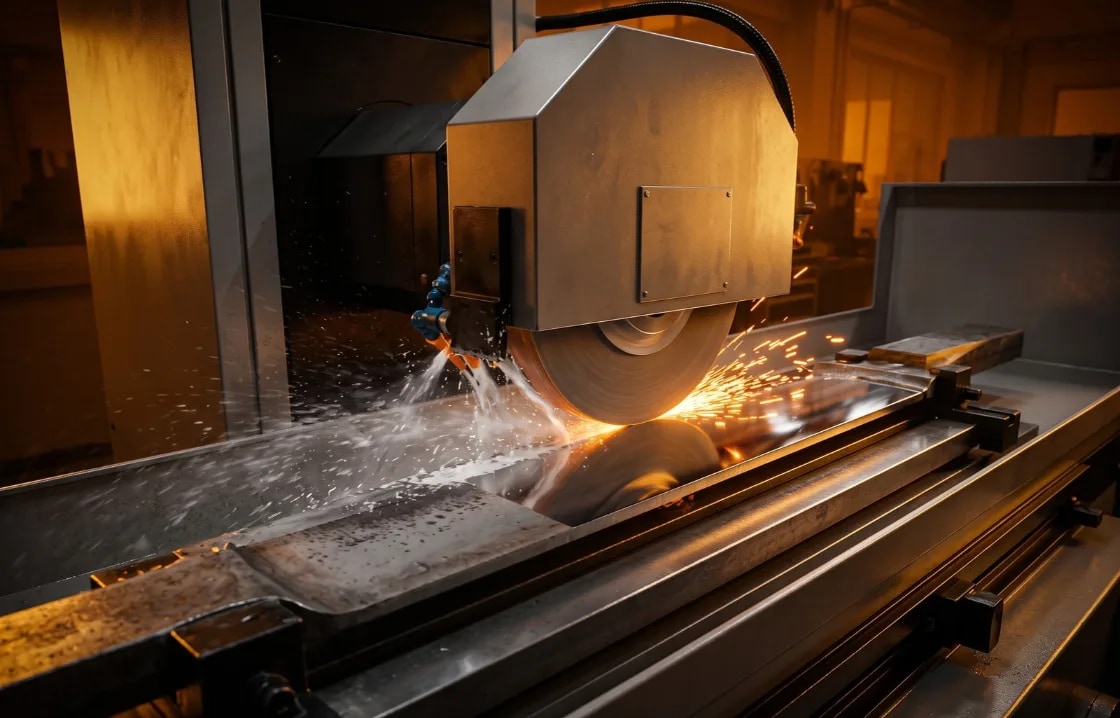
Precision grinding uses an abrasive wheel to bring hardened parts to final size and surface finish, reaching tolerances and roughness values that cutting tools cannot.
Surface, cylindrical and profile grinding finish parts after heat treatment, when distortion has to be corrected and final dimensions fixed. Flatness, parallelism, roundness and fine surface finish are all controlled by the grinding operation.
It is the standard finishing step for tooling, guides, shafts, dies and — at Snijer — for the blades and knives we make on our sister brand Snijer Blades.
 Surface, cylindrical and profile grindingHardened steel finished after heat treatmentTight flatness, parallelism and roundnessFine surface finish
After hardening, steel is too hard for most cutting tools and may have distorted. Grinding removes that distortion and delivers tolerances and surface finish beyond what milling or turning can reach.
CNC milling uses rotating multi-tooth cutters to shape flat surfaces, pockets, slots and contours in metal or plastic.
CNC turning rotates a workpiece against a fixed cutting tool to produce cylindrical parts such as shafts, bushes, flanges and…
CNC drilling produces accurately positioned round holes, from small cross-holes to deep-hole bores, with controlled depth…
5-axis machining moves the cutting tool along five axes at once, so complex shapes, undercuts and features on several faces are…