
CNC Milling
CNC milling uses rotating multi-tooth cutters to shape flat surfaces, pockets, slots and contours in metal or plastic.

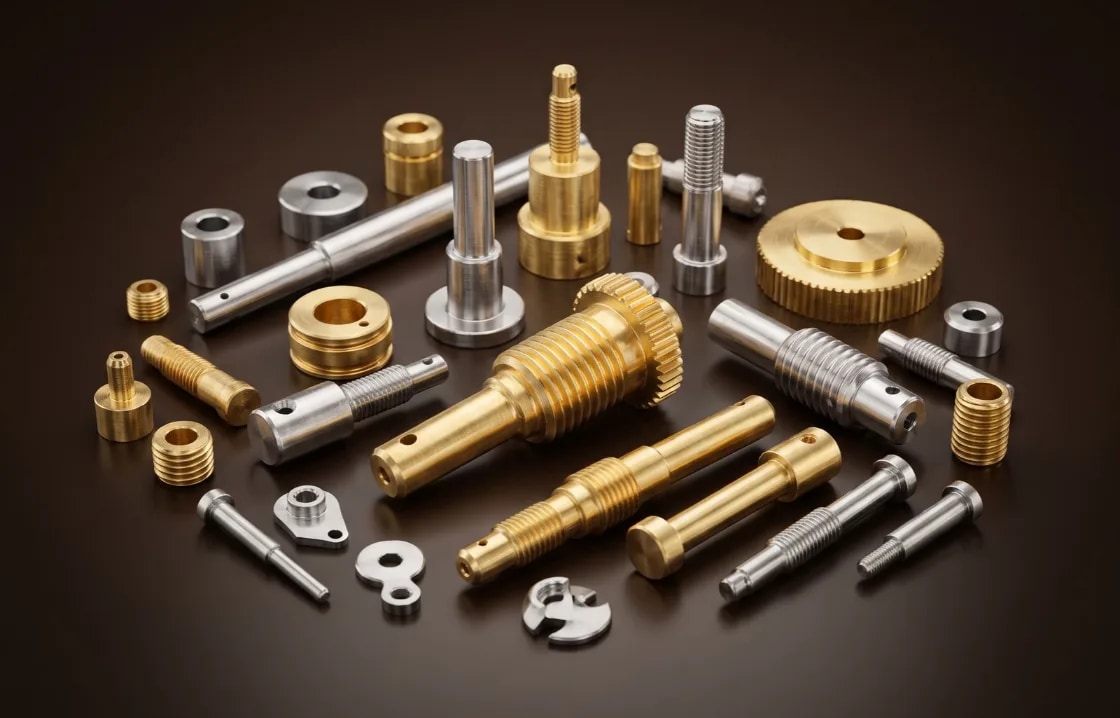
Part of CNC Machining
Swiss machining feeds bar stock through a guide bush so the cut is made right at the support point. It produces small, slender, high-precision turned parts with excellent repeatability.
Because the tool always cuts close to the guide bush, long and thin parts do not deflect. Swiss-type lathes with live tooling and a sub-spindle complete a part — turning, milling, drilling, cross-holes and cut-off — in one pass, which is why they suit micro-machining and high volumes.
Typical parts are pins, screws, connector bodies, dental and medical components, and watch- and sensor-sized precision details.
 Slender parts without deflectionComplete machining in one pass with sub-spindleMicro-machining of small diametersEfficient for high volumes
Swiss machining is used for small, slender, precise turned parts made in volume — for example medical screws, connector pins and sensor parts — where length-to-diameter ratio would make conventional turning inaccurate.
CNC milling uses rotating multi-tooth cutters to shape flat surfaces, pockets, slots and contours in metal or plastic.
CNC turning rotates a workpiece against a fixed cutting tool to produce cylindrical parts such as shafts, bushes, flanges and…
CNC drilling produces accurately positioned round holes, from small cross-holes to deep-hole bores, with controlled depth…
5-axis machining moves the cutting tool along five axes at once, so complex shapes, undercuts and features on several faces are…