
Water Jet Cutting
Water jet cutting uses a high-pressure stream of water, usually mixed with abrasive, to cut almost any material without heat.

Part of Sheet Metal Fabrication
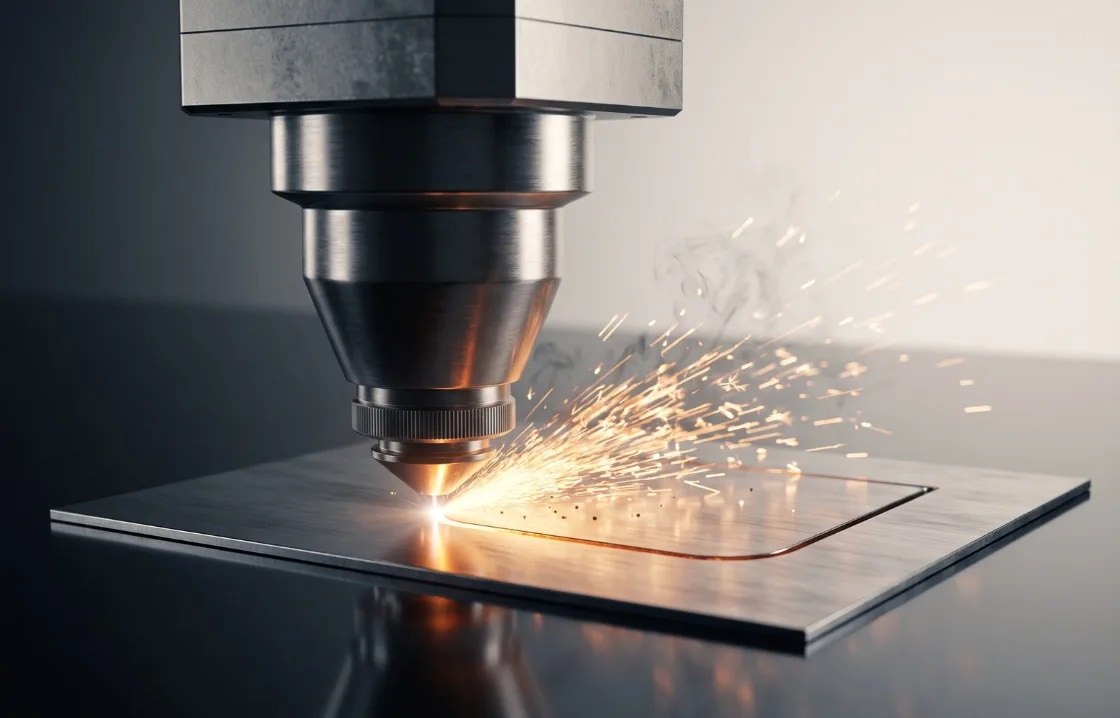
Laser cutting melts or vaporises sheet metal along a programmed path with a focused beam, giving fast, accurate cuts with fine detail and a narrow kerf.
A fibre laser cuts steel, stainless steel and aluminium with clean edges and small heat-affected zones, and nests parts closely to save material. Holes, slots, tabs and engraved marks are cut in the same pass, which makes laser cutting the usual first step before bending.
For very thick plate, copper-rich alloys or heat-sensitive materials, we recommend water jet cutting instead.
 Fibre laser for steel, stainless steel and aluminiumFine detail and narrow kerfClose nesting to save materialEngraved part marking
Yes, but it is narrow and usually irrelevant for structural sheet parts. If the cut edge must stay unaffected — for example before hardening or on heat-sensitive alloys — water jet cutting is the cold alternative.
Water jet cutting uses a high-pressure stream of water, usually mixed with abrasive, to cut almost any material without heat.
Metal bending folds flat sheet along straight lines with a press brake to form angles, channels and boxes.
Metal stamping presses sheet or strip between a punch and a die to blank, pierce and form parts in seconds.