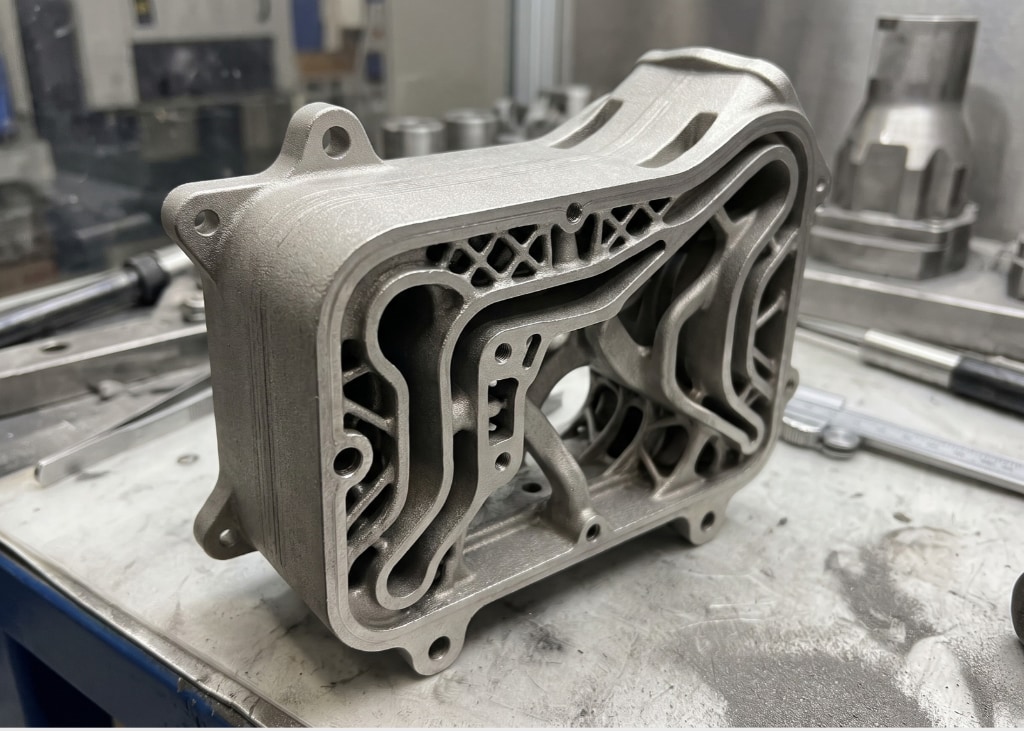
Industrial plastic 3D printing (polymer additive manufacturing) encompasses a family of advanced manufacturing processes that transform digital 3D CAD models into physical components layer by layer without the need for molds or cutting tools. Complex internal channels, lattice structures, thin-walled housings, and functional prototypes that are difficult or uneconomical to produce via conventional subtractive machining or injection molding can be realized directly through modern polymer 3D printing technologies.
Providing engineering-driven manufacturing solutions, Snijer supports industrial organizations across the entire product development lifecycle—from rapid prototyping to low- and mid-volume end-use production—through tailored 3D plastic printing services. Selecting the optimal additive technology, engineering polymer, and surface finishing workflow directly determines a component's mechanical durability, dimensional stability, and aesthetic quality.
What Are the Main Industrial Plastic 3D Printing Technologies?
Polymer-based additive manufacturing is categorized into four primary technology families based on the physical state of the raw feedstock (thermoplastic filament, granules, liquid photopolymer resin, or polymer powder) and the layer-bonding mechanism.
Material Extrusion (FDM / FFF and FGF)
Fused Deposition Modeling (FDM) / Fused Filament Fabrication (FFF) operates by melting a thermoplastic filament through a heated nozzle and depositing it along predetermined toolpaths onto a build platform layer by layer. For large-scale industrial structures, Fused Granulate Fabrication (FGF) feeds thermoplastic pellets directly into an extruder instead of filament.
- Key Advantages: Broad portfolio of engineering thermoplastics, cost efficiency, and scalability for large-format components.
- Typical Applications: Functional mechanical prototypes, manufacturing jigs and fixtures, protective equipment housings, and structural brackets.
- Engineering Considerations: Layer lines remain visible on unfinished surfaces, and interlayer thermal bonding results in anisotropic mechanical behavior along the Z-axis.
Vat Photopolymerization (SLA, DLP, MSLA, and Carbon DLS)
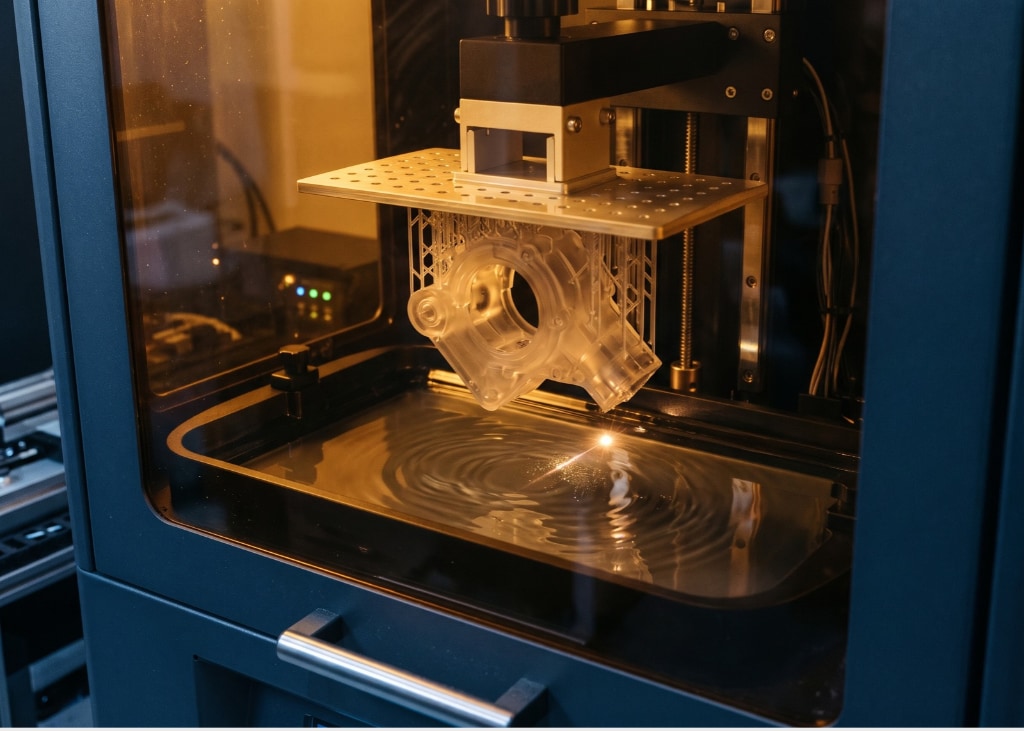
Vat Photopolymerization selectively cures a liquid thermoset photopolymer resin inside a vat using a controlled light source to build solid layers.
- SLA (Stereolithography): Uses a high-precision UV laser to trace and solidify each layer point by point, setting the benchmark for fine feature resolution and smooth surface finishes.
- DLP (Digital Light Processing) and MSLA: Projects a digital light mask or uses an LCD array to cure an entire layer simultaneously, significantly increasing build speed.
- Carbon DLS (Digital Light Synthesis): Utilizes an oxygen-permeable window and programmable UV projection to create a continuous liquid interface, followed by a thermal curing stage that yields near-isotropic mechanical performance and injection-molding-grade surface quality.
- Typical Applications: High-detail visual models, microfluidic manifolds, optical or transparent components, master patterns for silicone tooling, and durable end-use elastomer or rigid parts.
Polymer Powder Bed Fusion (SLS, MJF, and HSS)
Powder Bed Fusion processes spread thin layers of fine polymer powder across a build chamber and selectively fuse the particles using thermal energy. Because surrounding unsintered powder naturally supports the geometry during printing, no dedicated support structures are required.
- SLS (Selective Laser Sintering): A high-powered laser selectively sinters polymer powder particles—most notably Polyamide (PA12 and PA11)—layer by layer, enabling interlocking assemblies and complex geometries in a single print.
- MJF (Multi Jet Fusion): Multi Jet Fusion 3D printing deposits fusing and detailing liquid agents onto the powder bed via inkjet arrays before applying infrared energy to fuse the entire layer simultaneously, delivering high part density, crisp edge definition, and consistent mechanical properties.
- HSS (High Speed Sintering): Combines infrared-absorbing ink with thermal lamps to achieve high throughput suited for batch production.
- Typical Applications: Snap-fit enclosures, living hinges, air ducts, robotic end-of-arm tooling, and functional series-production components.
Material Jetting (PolyJet and MJP)
Material Jetting operates similarly to 2D inkjet printing by jetting microscopic droplets of liquid photopolymer onto a build tray and curing them instantaneously with UV light.
- Key Advantages: Ability to combine materials with varying hardness levels (Shore A durometers), flexibility, and colors within a single build cycle (overmolding simulation), alongside ultra-fine layer resolution.
- Typical Applications: Realistic industrial design prototypes, rigid housings with soft-touch grips, medical anatomical models, and complex multi-material assemblies.
Technical Comparison of Plastic 3D Printing Methods
The table below compares the leading industrial polymer 3D printing technologies across core engineering criteria:
| Technology | Operating Principle | Primary Materials | Surface Finish | Mechanical Properties | Ideal Applications |
|---|---|---|---|---|---|
| FDM / FFF | Melt extrusion of thermoplastic filament | ABS, ASA, PLA, PETG, PC, PA, TPU, PEEK, ULTEM | Visible layer lines, semi-matte | High impact and heat resistance; anisotropic in Z-axis | Functional prototypes, jigs & fixtures, large housings |
| SLA / DLP | UV curing of liquid photopolymer resin | Standard, Tough, Clear, Flexible, High-Temp Resins | Very smooth, glass-like finish | Isotropic structure; rigid or flexible depending on resin | High-detail visual models, transparent parts, master patterns |
| Carbon DLS | Continuous liquid interface + thermal bake | EPU, MPU, RPU, CE, EPX engineering resins | Injection-mold-grade smooth surface | High isotropy, superior elasticity and fatigue resistance | Functional end-use parts, elastomeric seals and lattices |
| SLS | Laser sintering of polymer powder | PA12, PA11, Glass-Filled / Carbon-Filled PA, TPU | Slightly grainy (micro-textured), matte | High toughness and strength; near-isotropic | Complex geometries, snap-fits, low-to-mid volume production |
| MJF | Liquid agent jetting + infrared fusing | PA12, PA11, PP, TPU | Uniform micro-textured, dark gray/black tone | High density, consistent isotropic strength | Functional batch production, thin-walled mechanical parts |
| PolyJet | Photopolymer droplet jetting + UV curing | Rigid, rubber-like (Agilus/Tango), transparent resins | Extremely smooth with sharp edges | Lower heat deflection; multi-durometer capability | Multi-material prototypes, ergonomic aesthetic models |
Industrial Polymer Materials Used in Plastic 3D Printing
Operating temperature, mechanical load profiles, and chemical exposure determine the appropriate polymer class for 3D printed plastic parts.
Standard and Functional Thermoplastics
- ABS (Acrylonitrile Butadiene Styrene): A staple engineering plastic in industrial product development. Well-balanced ABS mechanical properties—including high impact resistance, rigidity, good machinability, and reliable thermal stability—make it ideal for enclosures, automotive interior components, and functional test assemblies.
- ASA: Delivers mechanical performance comparable to ABS while providing superior UV and outdoor weather resistance without yellowing or embrittlement.
- PETG and PLA: PLA is suited for rapid conceptual validation and low-stress visual models, whereas PETG offers higher chemical resistance, moisture durability, and ductility for functional components.
Engineering Polymers
- Polycarbonate (PC): Offers exceptional tensile and impact strength alongside high heat resistance. Utilizing an industrial polycarbonate 3D printing service is ideal for heavy-duty protective guards, lighting housings, and demanding mechanical prototypes.
- PC-ABS Blends: Combines the high strength and heat resistance of polycarbonate with the flexibility and surface processability of ABS, making it widely adopted in automotive and electronics manufacturing.
- Polyamide / Nylon (PA12 and PA11): The workhorse polymers of SLS and MJF systems. PA12 provides low moisture absorption, dimensional stability, and chemical resistance, while bio-based PA11 offers higher elongation at break and impact absorption. Glass-bead (GB) or carbon-fiber (CF) reinforced variants further elevate stiffness and thermal stability.
Flexible Elastomers
- TPU and TPE: Thermoplastic elastomers offering rubber-like elasticity, abrasion resistance, and shock absorption across multiple Shore hardness grades for gaskets, bellows, vibration dampeners, and flexible couplings.
High-Performance Super Polymers
- PEEK, PEKK, and ULTEM (PEI): High-temperature engineering polymers exhibiting outstanding resistance to extreme heat, aggressive chemicals, and flame. They are deployed in aerospace, defense, medical sterilization devices, and energy systems to replace heavy metal components.
Specialty Photopolymer Resins
Processed in SLA, DLP, and Carbon DLS systems, SLA materials and engineering resins span standard smooth-finish formulations, ABS-like tough and durable resins, optically clear resins, high-heat-deflection resins, and skin-contact biocompatible grades.
Surface Quality and Mechanical Properties: Engineering Evaluation
Surface Finish and Dimensional Accuracy
Surface roughness (Ra) depends directly on layer thickness and feedstock phase:
- FDM / FFF deposits extruded thermoplastic beads, leaving visible layer striations and a stair-stepping effect on curved or angled faces. Optimizing build orientation minimizes roughness on critical mating surfaces.
- SLA, DLP, and PolyJet cure microscopic liquid resin layers, producing smooth, crisp surfaces comparable to molded parts straight off the machine.
- SLS and MJF components exhibit a uniform, matte, finely textured finish resulting from fused polymer powder particles. With no support structures required, parts are completely free of support-removal marks.
Mechanical Properties: Isotropy, Tensile Strength, and Impact Resistance
In additive manufacturing, part strength depends not only on raw polymer datasheet values but also on interlayer bonding quality:
- Anisotropy (Directional Strength): In FDM parts, thermal fusion between layers is weaker than the continuous polymer chains along the filament extrusion path. Designing parts so tensile loads align parallel to the layer plane maximizes structural integrity.
- Near-Isotropic Performance: Uniform powder-bed heating in SLS and MJF, as well as chemical cross-linking in Carbon DLS, minimizes mechanical differences across the X, Y, and Z axes—a critical requirement for multi-axially loaded end-use components.
Post-Processing Techniques for Enhanced Surface Finish and Performance
Raw polymer prints often undergo dedicated post-processing workflows to meet industrial end-use specifications.
1. Support Removal and Mechanical Surface Preparation
Support structures used in FDM, SLA, and PolyJet are mechanically removed or dissolved in specialized chemical baths. Powder-bed parts (SLS/MJF) undergo compressed-air cleaning and media / bead blasting to remove residual powder. Subsequent vibratory tumbling and precision sanding reduce surface roughness and create a uniform satin texture.
2. Vapor Smoothing
Developed primarily for PA12, PA11 (SLS and MJF), and ABS/ASA parts, vapor smoothing nylon and thermoplastic components exposes the printed geometry to a controlled solvent vapor inside a sealed chamber. The vapor selectively melts and reflows the outer polymer surface:
- Achieves an injection-molding-grade glossy, smooth finish.
- Seals surface porosity, preventing moisture absorption and creating liquid-tight, easy-to-clean surfaces.
- Eliminates microscopic surface notches, improving impact strength and fatigue life.
3. Chemical Washing and UV / Thermal Curing
Photopolymer parts are ultrasonically washed in isopropyl alcohol (IPA) or dedicated solvents to remove uncured liquid resin, followed by controlled-wavelength UV curing and thermal baking to complete polymer cross-linking and achieve peak tensile strength and heat deflection temperature.
4. Dyeing, Painting, and Protective Coatings
- Immersion Dyeing: Because sintered nylon possesses controlled surface porosity, SLS and MJF parts absorb pigments beneath the surface in heated dye baths, yielding wear-resistant deep black or custom colors without altering dimensional tolerances.
- Industrial Painting and Clear Coats: Priming and spray painting deliver automotive- or consumer-electronics-grade aesthetics, while wet sanding and UV-resistant clear coats restore optical clarity to transparent SLA parts.
- Functional Coatings: Conductive metallic coatings can be applied to polymer enclosures for EMI/RFI shielding.
5. Hardware Installation and Secondary CNC Machining
For assemblies requiring high-torque bolted joints, heat-set brass threaded inserts are installed into printed bosses. Critical bearing bores or tight-tolerance datum faces can also be finished via secondary CNC machining.
Selecting the Right Manufacturing Route for Your Project
Every manufacturing method offers distinct engineering advantages. When design validation, complex internal geometries, and rapid delivery without tooling investment are priorities, an engineering-led plastic 3D printing service provides unmatched agility. When micron-level tolerances and homogeneous billet properties are required, CNC plastic machining excels, whereas high-volume mass production favors plastic injection molding for low unit cost.
Snijer evaluates your CAD geometry, mechanical load requirements, and production volume targets from an engineering perspective to help you choose the optimal path between additive manufacturing, CNC machining, and injection molding. To discuss your polymer additive manufacturing requirements with our technical specialists, please contact our team.
Frequently Asked Questions
Which industrial plastic 3D printing technology offers the highest mechanical strength?
For functional end-use components requiring high strength and directional consistency (isotropy), SLS (Selective Laser Sintering) and MJF (Multi Jet Fusion) processing Polyamide (PA12, PA11) or carbon/glass-fiber-reinforced composites typically deliver the strongest results. For extreme thermal and chemical environments, high-temperature industrial FDM systems processing PEEK and ULTEM provide superior mechanical performance.
What are the main differences between SLS and Multi Jet Fusion (MJF)?
Both technologies are support-free powder bed fusion processes. SLS uses a point laser to sinter polymer powder particles and supports a broader catalog of specialty composites and elastomers. MJF uses liquid fusing and detailing agents combined with infrared heating to fuse an entire layer at once, resulting in higher part density, sharper edge resolution, and a uniform dark gray or black surface finish.
How does 3D printing vs injection molding compare for low- and mid-volume production?
When comparing 3D printing vs injection molding, additive manufacturing eliminates upfront mold tooling costs and lead times, making it far more economical and agile for prototypes, design iterations, and low-to-mid production runs. Once annual production volumes scale into the thousands of identical parts, injection molding becomes more cost-effective per unit.
Can transparent or flexible rubber-like plastic parts be 3D printed?
Yes. Optically clear components can be produced via SLA or a specialized PolyJet 3D printing service using transparent photopolymers, followed by wet sanding and clear UV coating for glass-like clarity. Flexible, impact-absorbing parts can be manufactured using TPU/TPE elastomers on SLS, MJF, and FDM platforms, as well as rubber-like photopolymers on PolyJet and Carbon DLS systems.